Michelin Tires, Explained: Racing Line vs Performance Line, and Every Tread
Michelin bundles the casing and the compound into a single word, so one of its tires is two decisions instead of three. Here is what Racing Line and Performance Line actually buy you, why the DH numbers are not a scale, and the pairing to run.
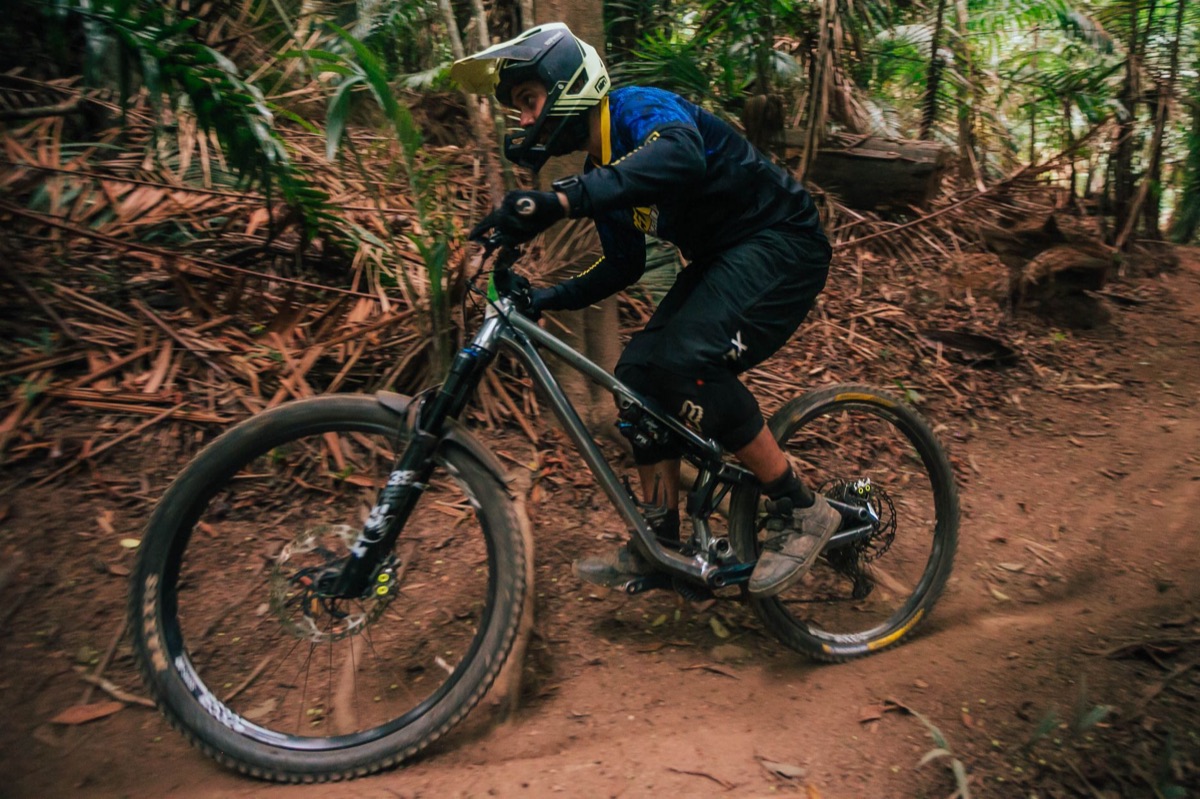
A Michelin mountain bike tire is two decisions instead of three. Pick the tread, pick the Line. The Line carries the casing and the compound together, so once you know what MS means and what Racing Line means, the tire is specced.
That is less work than the grid Continental sells or the five-part sidewall Schwalbe prints. The catch is that Michelin has four tier words and none of them announce their own order.
the lines, and what the words are worth
Two compound names run through all of it. Magi-X is the soft grippy rubber. Gum-X is the harder, faster, longer-lasting one.
| Line | What you get | Price |
|---|---|---|
| Racing Line | Double-ply 55 TPI casing, 100% Magi-X across the whole tread | $99.99 |
| Performance Line | Double-ply 33 TPI casing with thicker, softer plies and a bead-to-bead shield. Gum-X centre, Magi-X shoulders | $85.99 |
| Competition Line | The older Gravity Shield casing. Only left on trail treads now, like the Wild AM2 | $67.99 |
There is an Access Line below all of it. That is commuter rubber, and it does not appear on a mountain bike.
Within any one tread the ladder runs Racing, Competition, Performance, Access. Nothing in those words tells you that, and "Competition" reading as more serious than "Performance" is the single most common way people misread a Michelin listing. The price is the faster signal. On the gravity treads you only have to hold two of them anyway: the Wild Enduro and DH ranges come as Racing Line or Performance Line, and Competition Line is what survives on the older trail tires.
racing line or performance line?
Performance Line landed in the US and Canada on 7 January 2026 and reads like the budget option, which undersells it. The tread pattern is identical. What changes is the rubber map: Gum-X runs down the centre strip and Magi-X stays on the shoulders. The centre strip is the part that drags and the part that wears out. The shoulders are the part that corners.
The casings differ in feel rather than toughness. Racing Line uses a stiffer double-ply 55 TPI carcass that holds its shape when you lean on it at low pressure, which is why it feels precise and why it wants to be ridden hard. Performance Line uses a 33 TPI casing with thicker, softer plies, so it takes the edge off small chatter and costs you less over a four-hour day. Michelin puts the grip difference between the two at roughly 20 percent.
the compounds
| Compound | What it is | Where it shows up |
|---|---|---|
| Magi-X | The grippy one, adapted from Michelin motorcycle racing rubber. Slower rolling, faster wearing | The whole Racing Line tread, and the shoulders of a Performance Line tire |
| Magi-X DH | The downhill-specific version of the same idea | DH16, DH22, DH MUD |
| Gum-X | The balanced one. Rolls faster and lasts longer, gives up outright grip | Performance Line centres, trail and XC tires, DH34 Bike Park |
Two compounds is the whole system, which is half what Maxxis, Schwalbe and Continental each ask you to choose between. The detail worth knowing is that Michelin tunes Magi-X to keep working between about 3 and 10 degrees Celsius. Cold is where hard rubber turns to plastic and quietly stops gripping, so if your season is a wet European-style winter rather than a dusty summer, that is the strongest argument Michelin makes.
the enduro treads
| Tread | Built for |
|---|---|
| Wild Enduro MS | Mixed Soft. Loose, wet and churned dirt, on open widely spaced knobs. The front tire |
| Wild Enduro MH | Mixed Hard. Hardpack and rock, tighter knobs, faster rolling. Works at either end |
| Wild Enduro Rear | Rear-specific. Short centre knobs for drive and braking, reinforced shoulder blocks |
Three treads is the entire enduro range, and Michelin has kept them unchanged through two casing overhauls because they were developed on the World Cup circuit. Sizes are 2.40 and 2.50 in both 27.5 and 29, with the Performance Line rear in 29x2.40 only. If you were hoping for a 2.6, there is not one, and that alone rules Michelin out for some bikes.
the downhill treads
| Tread | Built for |
|---|---|
| DH22 | Mixed and soft ground. The versatile one, and the front tire if you buy a single Michelin DH tire |
| DH16 | Hard, dry and rocky. The most compact tread, so the most rubber on the ground and the fastest of the race tires |
| DH MUD | Mud. Nothing else |
| DH34 Bike Park | Hardpack and lift laps. Gum-X on a cheaper 4x33 TPI casing, not a race tire |
The numbers are inherited pattern names off the motorcycle side of the business, not a scale. A higher number is not grippier, tougher or newer. DH16 and DH22 share a 55/120 TPI dual-ply Down Hill Shield casing with Magi-X DH, come in 2.40 only across 27.5 and 29, and cost $99.99. The 2024 rework of both claimed a 19 percent cut in rolling resistance.
DH34 is where it bites. The DH34 you can actually buy in the US is the Bike Park version at $68.99, built on Gum-X and a 4x33 TPI casing. It is a good durable park tire and it is roughly 100g lighter, but it is not the race construction the DH16 and DH22 are. Same DH prefix, different product, and the price gap is the tell.
what to actually buy
For aggressive trail and enduro: a Wild Enduro MS in Racing Line up front with a Wild Enduro Rear out back. That pairing is Michelin's answer to a DHF and a DHR II, and it is what most bikes running this brand are wearing. Swap the front to the MH if your trails are hardpack and rock, and take the Performance Line rear unless you are bending rims.
For downhill and bike park: a DH22 front with a DH34 Bike Park rear, which also happens to be the cheapest way to run a full gravity set from this brand. Go DH16 on the front instead if your track is dry and rocky and you want the speed.
The whole gravity range is in the Buildernow, both Lines in both wheel sizes, so it will size the pairing against your frame and tell you when the rear you picked is softer than the front. Choose the tread, let it handle the rest.
michelin vs maxxis, schwalbe and continental
Michelin is the cheapest way into a premium European tire. A Performance Line Wild Enduro is $85.99 against a Schwalbe Pro radial a little over $100, and it asks you to make fewer decisions than anyone: two compounds, two gravity lines, three enduro treads. Where Continental gives you a clean grid of independent choices, Michelin has already made most of them for you.
The catches are real. US distribution is thin: Competitive Cyclist is the only retailer carrying the whole range, and Jenson stocks the Racing Line without the Performance Line, the DH34 or the DH MUD. The gravity range stops at 2.50 with no 2.6, and the DH tires are 2.40 only. There is no radial answer to Schwalbe and no equivalent to the reworked casing Maxxis launched this August. Michelin is not chasing the technology race, it is selling proven treads at a lower price.
So: if you ride cold, wet, natural trails and you want World Cup rubber without the World Cup receipt, Michelin is the best value in this series. If you need a 2.6, or you want the newest casing technology on the market, look at one of the other three.
common michelin questions
- What is the difference between Michelin Racing Line and Performance Line?
- They are the same tread patterns built two ways. Racing Line uses a double-ply 55 TPI casing and 100 percent Magi-X, Michelin grippiest compound, across the whole tread, and costs $99.99. Performance Line uses a double-ply 33 TPI casing with thicker, softer plies plus a bead-to-bead shield, and runs a bi-compound tread with harder Gum-X down the centre and Magi-X on the shoulders, for $85.99. Michelin claims the Racing Line delivers about 20 percent more grip.
- What is the difference between Magi-X and Gum-X?
- Magi-X is the grippy compound, adapted from Michelin motorcycle racing rubber and tuned to keep working in cold, damp conditions around 3 to 10 degrees Celsius. It rolls slower and wears faster. Gum-X is the balanced compound, with lower rolling resistance and longer life at the cost of outright grip. Magi-X DH is the downhill-specific version of Magi-X used on the DH16, DH22 and DH MUD.
- What do the numbers in Michelin DH16, DH22 and DH34 mean?
- They are inherited tread pattern names, not a scale. A higher number is not grippier or tougher. DH16 has the most compact tread and suits hard, dry, rocky tracks. DH22 is the most versatile and the one to buy if you are only buying one. DH MUD is the mud spike. DH34 in the US is sold as the DH34 Bike Park, which uses Gum-X on a cheaper 4x33 TPI casing rather than the Magi-X DH race construction.
- Which Michelin tire goes on the front and which on the rear?
- The Wild Enduro MS is the front tire, with an open knob layout for loose and soft ground. The Wild Enduro Rear is the rear-specific partner, with short centre knobs for drive and braking and reinforced shoulders. The Wild Enduro MH sits between them and works at either end on hardpack. In the downhill range the DH22 is the usual front and the DH16 or DH34 Bike Park the usual rear.
- How much do Michelin mountain bike tires cost?
- Gravity Racing Line tires, meaning the Wild Enduro MS, MH and Rear plus the DH16, DH22 and DH MUD, are $99.99. Performance Line versions of the Wild Enduro treads are $85.99. The DH34 Bike Park is $68.99 and the trail-focused Wild AM2 Competition Line is $67.99. That makes Michelin the cheapest way into the premium European bracket.
- Are Michelin mountain bike tires good?
- Yes, and the tread bench is genuinely strong, with the DH22 and Wild Enduro MS both proven at World Cup level. The practical catches are availability and sizing rather than performance. US distribution is thin, with Competitive Cyclist the only retailer carrying the whole range and Jenson USA stocking the Racing Line alone, the gravity range tops out at 2.50 inches with no 2.6 option, the downhill tires come in 2.4 only, and Michelin has no answer to Schwalbe radial casings.
Tread for terrain, Line for everything else. Michelin is the only one of the four that folds casing and compound into one word, which makes it the fastest range to shop and the easiest to misread, and the entire trick is remembering that the tier names are not in the order they sound like.
Front and rear, already matched.
The Builder's Recommended Setups fill your tire slots with a pairing that suits the conditions you name, in the right wheel size for your frame. The Michelin gravity range is in the list, so the pairing it hands you is the one you buy.
- filed under · build roadmap
Is There a PCPartPicker for Mountain Bikes? (Yes, and Here’s How It Works)
 filed under · suspension setup
How to Set Sag on a Mountain Bike (Front + Rear, by Discipline)
 filed under · compatibility
How to Build a Mountain Bike From Parts (And the Compatibility Traps)
 filed under · build roadmap
What Order to Choose Parts for a Custom MTB Build (Frame First, and Why)