Coil vs Air Shock: Which One Belongs on Your Bike?
One uses compressed air as the spring, the other uses a steel coil. The ride feel, the maintenance, and the tuning are genuinely different, and some frames flat-out can't run a coil. Here's how to pick.

Every rear shock has two jobs: a spring that holds you up, and a damper that controls how fast the suspension moves. The damper side is similar on both types. The spring is the whole argument. An air shock uses compressed air in a sealed chamber as its spring. A coil shock wraps a steel spring around the shock body and calls it a day.
That one difference changes how the shock feels, what it weighs, how you tune it, and how much attention it needs. It also decides whether your frame can even run one, which is the part most people find out about last.
how an air shock works
You set the spring by pumping air in or letting it out with a shock pump (a small high-pressure pump with a gauge). More air, firmer spring. Less air, softer. That means the same shock fits a 120 lb rider and a 240 lb rider, just at different pressures.
Air springs also ramp up naturally: the deeper the shock compresses, the harder the air pushes back, because you're squeezing the same air into a smaller space. That built-in ramp resists bottoming out (using all the travel with a clunk). You can tune how aggressive the ramp is with volume spacers, little plastic blocks that shrink the air chamber.
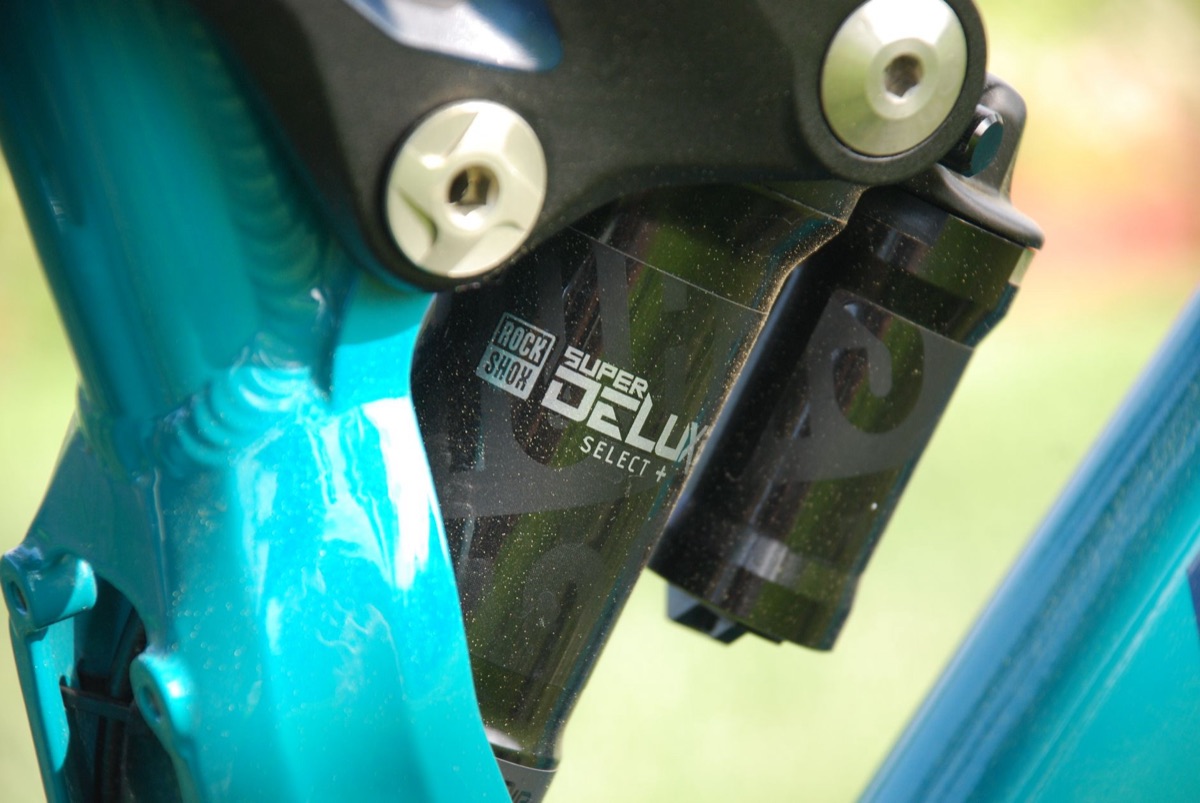
how a coil shock works
A coil spring has a fixed stiffness called a spring rate, printed on the spring in pounds per inch, like 400, 450, or 500. Springs come in 25 or 50 lb steps, and you buy the one that puts you at the right sag for your weight. A threaded preload collar fine-tunes from there, but only barely: if you're winding it more than a turn or two past snug, you need a different spring, not more preload.
A coil is linear: the force it takes to compress the first 10mm is the same as the last 10mm. No natural ramp-up. Combine that with almost no seal friction (there's no high-pressure air chamber to seal) and you get the coil's signature feel: the wheel responds to small bumps an air shock would skate over.
can my frame even run a coil?
This is the question to answer before you spend money. Frames are designed around a leverage curve, which is how hard the frame pushes on the shock through its travel. Some frames get more supportive as they go deeper (called progressive), and those pair fine with a linear coil. Frames that stay flat or get softer deeper in the travel (linear frames) rely on the air spring's ramp-up to avoid slamming through their travel. Put a coil on one of those and you'll bottom out constantly.
Manufacturers usually say “coil compatible” or “not coil compatible” somewhere in the frame spec. The Builder tracks this per frame, so if you pick a coil shock that your frame can't support, it gets flagged before checkout instead of after your first ride.

coil vs air, side by side
| What matters | Air | Coil |
|---|---|---|
| Small-bump feel | Good | Best in class |
| Bottom-out resistance | Built in, tunable | Needs a progressive frame |
| Weight | Lighter by 300–500g | Heavier |
| Adjusting for rider weight | Free, with a pump | Buy the right spring |
| Long-descent consistency | Can fade when hot | Dead consistent |
| Maintenance | Air can service ~every 50h | Less frequent |
| Works on any frame | Yes | No, check the frame |
so should you run a coil?
- ›Coil makes sense if you mostly descend, ride enduro or DH, your frame is coil compatible, and you want maximum traction and a shock that behaves the same on minute one and minute twenty.
- ›Air makes sense if you pedal as much as you descend, care about weight, like to experiment with your setup, or ride a frame that isn't built for a coil. For trail and XC bikes, air is the default for good reason.
- ›Either way, sag comes first. A well-set-up air shock beats a badly sprung coil every time. Set sag around 30% for gravity riding, and remember the target is set by discipline and feel, not by how much you weigh.
One more practical note: shocks are sized by eye-to-eye (mount to mount, e.g. 210mm) and stroke (how far it compresses, e.g. 55mm), printed like 210x55. Coil or air, the replacement has to match what your frame takes. The Builder filters shocks to your frame's size automatically, which is one less spec sheet to squint at.
Not every frame can run a coil. The Builder knows which.
Pick your frame in the Builder and it flags coil compatibility for you, along with the eye-to-eye and stroke sizes your frame actually takes. No forum digging, no guessing.
 filed under · build roadmap
Is There a PCPartPicker for Mountain Bikes? (Yes, and Here’s How It Works)
 filed under · compatibility
How to Build a Mountain Bike From Parts (And the Compatibility Traps)
 filed under · build roadmap
What Order to Choose Parts for a Custom MTB Build (Frame First, and Why)
 filed under · disciplines & bike types
Hardtail vs Full Suspension: Which Mountain Bike Should You Actually Buy?